
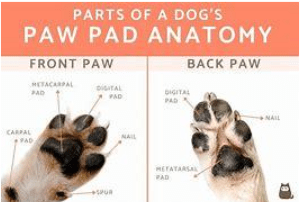
A dog’s paw pad is made up of fat, connective tissue, and collagen. The pads consist of thick, tough skin designed to protect a dog’s feet. The underside of a dog’s paws has pads that cushion their feet and provide traction. There are usually four main pads on the bottom of the paw – one large central pad called the metacarpal or metatarsal pad, and three smaller digital pads, one for each toe. The pads are rough and textured, which helps grip different surfaces as a dog walks. In between the pads are grooves that allow flexibility and promote better traction. While the pad is mostly hairless, some breeds have small tufts of fur between the pads or on the top of the feet. The thick pad allows a dog to walk on rough or hot surfaces like concrete, gravel, snow, or asphalt.
Each dog has distinct skin patterns on their paw pads, similar to human fingerprints. The tiny ridges, loops, and whorls that make up a dog’s paw print are one-of-a-kind from dog to dog. Even puppies from the same litter will have variations in their paw pad skin patterns. This individuality comes from differences in how the skin on the paw pads develops in utero. The friction ridges form randomly as the skin layers grow, creating distinctive patterns and markings. Just like no two human fingerprints are exactly alike, no two dogs share the same paw pad skin patterns.
Dog paws change from when they are puppies and continue to change throughout the Golden Years. The unique pattern of a dog paw print simply changes but continues to be quite different from their fellow canines. The only reason the unique pattern on a dog’s paw isn’t considered a “fingerprint” is because it changes.
In addition to the dog’s paw prints changing due to age, it also goes through a lot of abuse. Just think about how much your dog walks, runs, and jumps, especially on concrete! All of that scraping definitely changes a dog paw print, so there’s no way it can ever be considered a unique fingerprint
There is no centralized database for recording and analyzing canine paw print patterns, like fingerprint databases used in human forensics. Developing such a database with enough detail would be extremely difficult.
Overall, while dogs do have distinctive pad patterns that are unique to each individual, there are practical challenges to developing a reliable identification system based on these prints alone.
This may come as a surprise but it’s the dog’s nose print that is the human equivalent of the fingerprint. All dog nose prints are unique and do not change over time.
So, if you’re trying to identify a dog, take a dog nose print and compare it to one done as a puppy. You’ll find a match and only one match.
Unfortunately, since dogs don’t participate in crimes as much as humans do, there is no need to record all dogs’ nose prints. It’s just good to know that dog paws are not the same as fingerprints, but rather, it’s dog nose prints.
 Mon Valley Paws